


The part of your school’s energy bill that rises whatever the market does
Wholesale prices make the headlines. But for a school, more than half of every electricity bill is made up of charges that are set by regulation, published in advance and rising on a known path.
When energy is in the news, the story is almost always the wholesale price. Gas storage, cold weather and events overseas all move it, and this autumn the moves were sharp.
Yet a school that only watches the wholesale market is watching less than half of its electricity bill.
The rest is made up of charges for using the national and local networks, and for government policy schemes. They do not move with the market. They are set by the regulator and the system operator, published on fixed annual timetables, and they are heading in one direction.
According to Better Connected, an advisory led energy and carbon consultancy working with school estates, that makes them the one part of an energy budget a school can see coming.
The wholesale price is now the smaller part of the bill
For a typical business electricity supply, the wholesale cost of the power itself now accounts for around 40% of the delivered price, Better Connected says. Everything else sits in what the industry calls non commodity costs.
These fall into two groups.
Network charges pay for the transmission system that carries power across the country, and for the local distribution network that brings it to the school gate. On a bill they appear as Transmission Network Use of System (TNUoS) and Distribution Use of System (DUoS) charges.
Policy charges fund government schemes, for example support for renewable generation, standby capacity for peak demand and, more recently, new nuclear power stations.
A school cannot shop around for these. Every supplier pays the same underlying charges and passes them on. What differs is how each supplier builds them into a contract, and that is where the detail matters.
Gas is simpler. Far fewer of these charges apply, so the wholesale price still makes up most of a gas bill.
What the next five years look like
Better Connected recently prepared a forecast of these charges for a boarding school client planning its next contract. The direction it shows will apply to most schools with any metered electricity.
- Electricity non commodity costs are forecast to rise by about a third between 2026/27 and 2031/32.
- The rise comes early. They are about 13% higher in 2027/28 and about 19% higher by 2028/29.
- Gas non commodity costs rise far more gently, by about 3% in 2027/28 and about 12.5% over the whole period.
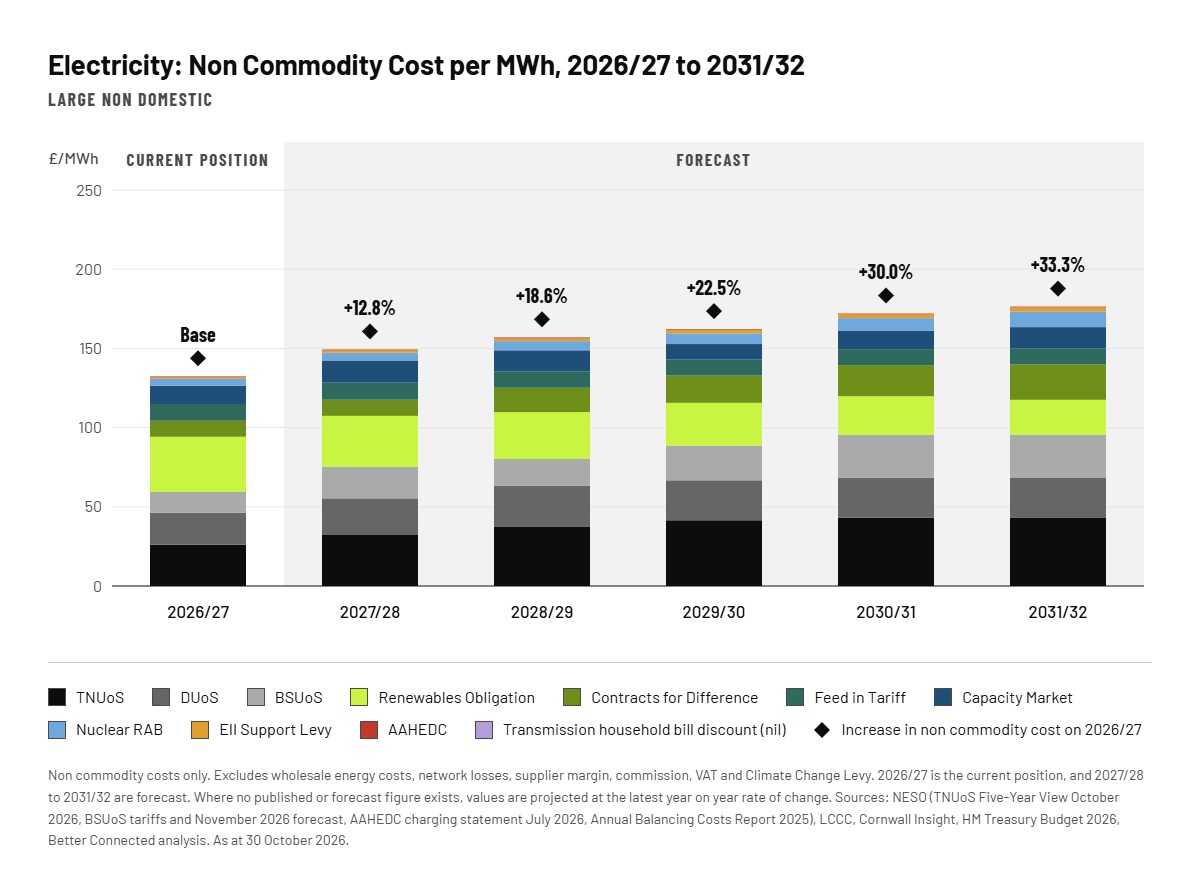
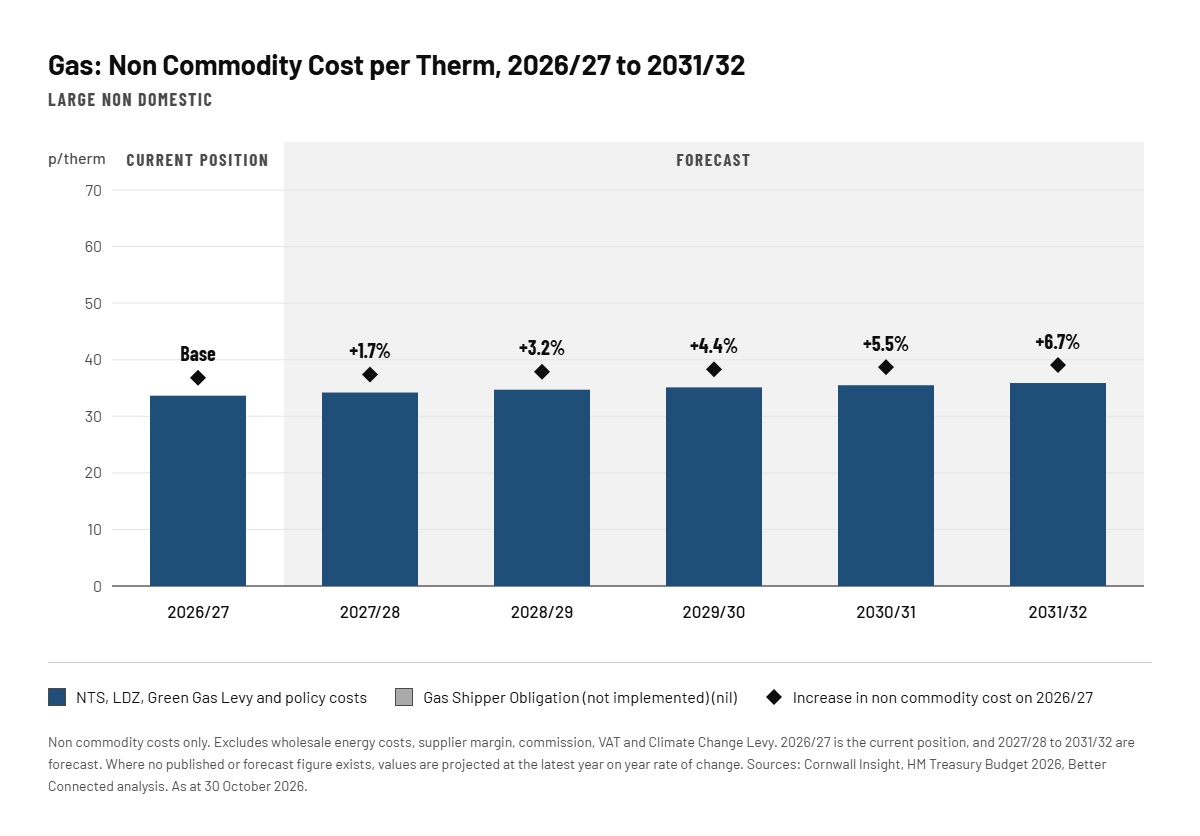
The main driver in the near years is the transmission charge, which is rising to pay for upgrades to the national grid. From 2028/29 the local distribution charge adds to it, along with a newer charge to fund nuclear generation. The larger established policy costs are broadly steady.
“A school can do nothing to avoid these charges, but it can know about them. They are published, they are scheduled, and they belong in the budget before the renewal quote arrives.”
Better Connected | Expert Energy Insight
The forecast was built for one school estate, and the level of these charges varies with region, meter type and the capacity of each supply. The nearer years rest on published figures and official forecasts. The years beyond 2028/29 carry more of Better Connected’s own projection and should be read as indicative.
Why these costs can be planned for
Nobody can say where the wholesale market will be next spring. Network charges are different, because they are set through a regulated process and published ahead of time.
Transmission tariffs for each April are confirmed in the January before, and the system operator publishes a five year view of where they are heading. Local distribution charges are published around 15 months before they take effect.
That gives schools something unusual in energy: a cost line with a timetable. A finance team building the 2027/28 budget does not need to guess at this part of the bill. It needs to ask for it.
It also changes how a move in the wholesale price should be read. If the market falls by 10%, an electricity bill does not fall by 10%, because the wholesale price is well under half of it. If network charges rise in the same year, the total may not fall at all.
Fixed does not always mean every charge is fixed
Many schools choose a fully fixed contract for budget certainty, and with good reason. A fully fixed contract fixes both the energy price and the non commodity charges for the whole term.
But “fully fixed” is a supplier’s label, not a standard. Some suppliers pass through part of the transmission charge instead of fixing it. Some pass through capacity or reactive power charges. Two offers with a similar headline rate can carry different exposure to the very charges that are rising fastest.
Better Connected checks every offer for these items, so that like is compared with like before a recommendation is made.
Before comparing prices, ask each supplier to confirm in writing which network and policy charges the offer fixes and which it passes through.
What this means for the 2027/28 budget
For a school whose next contract starts in 2027, the year that matters most is 2027/28. On Better Connected’s forecast, electricity non commodity costs in that year sit about 13% above this year’s, and gas about 3% above.
Three practical points follow.
Budget the two parts separately. The wholesale part of the bill stays uncertain until a contract is fixed. The non commodity part can be estimated now, from figures that are already published.
Do not wait for these charges to fall. Timing can help with the wholesale price. It cannot help with network and policy charges, which rise whenever a school chooses to fix.
Check the capacity on each supply. Several network charges are based on the agreed capacity of a supply, not on the energy used. A school paying for more capacity than it needs pays these rising charges on capacity it never draws. Reviewing it is one of the few ways to bring them down.
Five questions to ask before the next budget round
The cost you can see coming
Energy budgets tend to be built around the number that is hardest to predict. The more useful starting point is the part that has already been published.
Know the split. Know the forecast. Know what your contract fixes. Then the wholesale price becomes one decision among several, not the whole of the energy budget.
Speak to Better Connected
To see what network and policy charges look like for your school or trust in the next budget year, contact the Better Connected team.
Better Connections Limited
Telephone: 0161 710 2136
Website: betterconnected.biz
Phil Jones, phil.jones@bc-consultants.co.uk
Sean Curgenven, sean.c@bc-consultants.co.uk

