
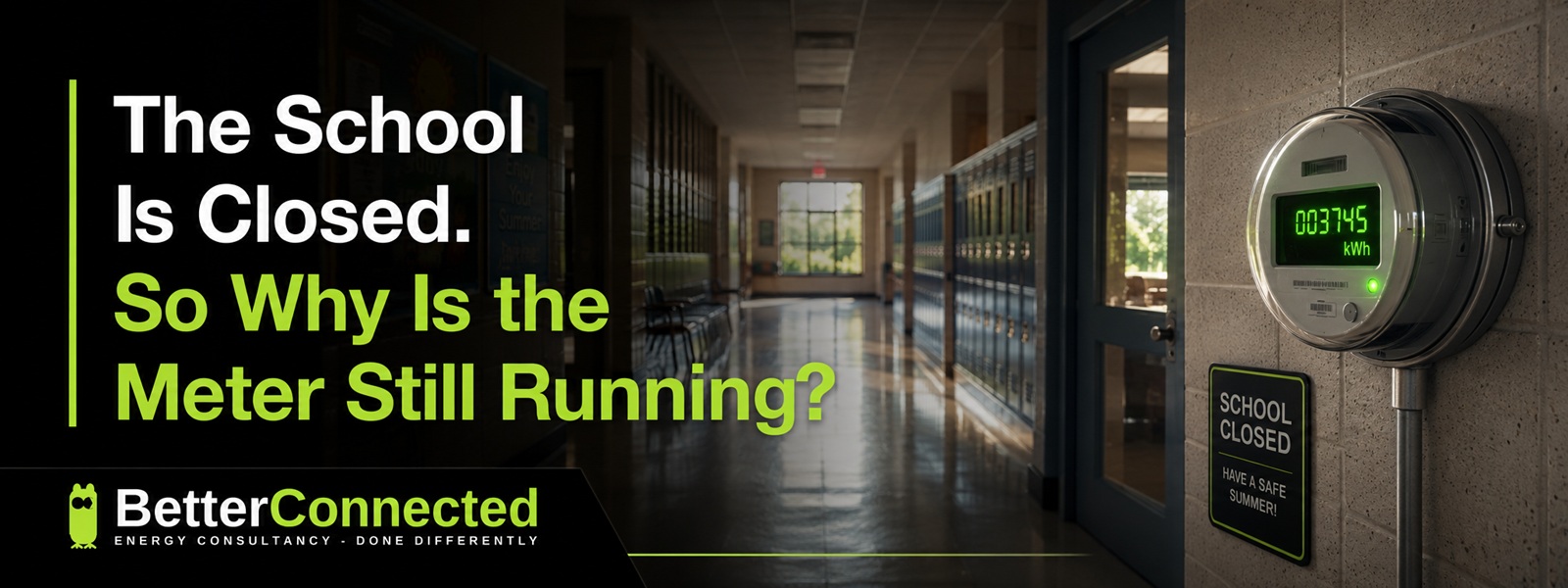
The School Is Closed. So Why Is the Meter Still Running?
Walk through most schools in the middle of August and they feel very different.
Classrooms are empty. Corridors are quiet. The dining hall may be closed. There are no assemblies, no normal teaching day and, depending on the school, considerably fewer people moving around the estate.
The electricity meter, however, has not stopped.
Nor should it.
Schools are complicated buildings. Servers, alarms, refrigeration, communications equipment and security systems still need power. Some sites have swimming pools, boarding accommodation, holiday clubs, summer lettings or contractors working throughout the break. Pumps, ventilation and other building services may need to remain operational.
So the interesting question is not whether a school uses energy during the summer.
It is whether it understands what is still being used, when it is being used and why.
For schools looking closely at operating costs ahead of another academic year, August provides a particularly useful window in which to find out.
What Does Your School Look Like With the Timetable Removed?
During term time, energy use is affected by almost everything happening across the estate.
Pupils arrive. Kitchens start operating. IT suites fill up. Sports facilities come into use. Heating and ventilation schedules change through the day. Evening activities and community lettings may extend occupation well beyond the final lesson.
That makes the normal school energy profile busy.
The summer break strips much of that activity away.
What remains is often referred to as the building’s baseload: the level of energy being consumed even when normal occupancy has fallen substantially.
Baseload itself is not evidence that anything is wrong. In a boarding school, a school running holiday provision or a site with specialist facilities, it may be entirely expected.
But if nobody can explain the shape of that demand, it deserves a closer look.
The Department for Education makes a similar point in its energy-efficiency guidance . It recommends regular monitoring of energy use and notes that half-hourly readings provide enough detail to identify patterns and show how much energy is being used when a building is unoccupied.
The school holidays are more than downtime. They can act as a useful diagnostic period.
Start With the Shape, Not the Total
An annual energy figure tells a school how much it consumed.
It does not tell the school much about how it consumed it.
Two schools with similar annual electricity use could have very different problems.
One may have high daytime demand because of the nature of its facilities. Another may have a surprisingly large amount of electricity being drawn overnight.
Likewise, a multi-academy trust may see an acceptable portfolio-wide figure while one academy is behaving very differently from the rest.
This is where more detailed consumption information becomes useful.
A relatively simple comparison can often be revealing:
What happened to electricity demand after the final day of term?
Did consumption fall sharply, gradually or hardly at all?
What does the site draw at 2am?
Is Saturday different from Tuesday?
Are there unexplained spikes when the building is supposed to be largely unused?
If a trust operates several similar schools, does one have a noticeably higher out-of-hours profile?
Those questions do not immediately tell you the cause. They tell you where to look.
And that distinction matters.
Something Running Does Not Necessarily Mean Something Is Wrong
It is easy to turn energy-efficiency discussions into a hunt for things that have been “left on”.
Real school estates are rarely that simple.
A high summer load might come from a swimming pool that remains operational, refrigeration that cannot be switched off, essential IT infrastructure or a nursery operating through the holidays.
A boarding school cannot be assessed in the same way as a term-time primary school.
Even within one trust, two academies may have completely different operating patterns.
The useful exercise is therefore not to impose an arbitrary target for what summer consumption should be.
It is to establish what is normal for that building and then identify what cannot readily be explained.
Sometimes there will be an operational answer.
Sometimes the data may point towards heating or hot-water controls that were never moved onto holiday settings, plant operating for longer than expected, equipment running overnight or parts of an estate consuming energy despite being unused.
In other cases, the issue may sit somewhere else entirely.
The meter data may not match the bills. Estimated reads may be involved. Metering arrangements may need checking. A capacity setting may date back to a very different use of the building.
Energy data can raise the question without necessarily providing the diagnosis.
For Trusts, Look Site by Site
The exercise becomes particularly useful across a school group or multi-academy trust.
A combined annual figure can hide a great deal.
Imagine a trust with six academies. Five show a clear reduction in demand during the first week of the holidays. One does not.
That academy immediately becomes worthy of attention.
It does not mean the site is inefficient. It may have a perfectly valid reason for maintaining a higher load.
But the trust now has a question worth answering.
That is a much more useful starting point than telling every school to cut its consumption by the same percentage.
It also allows finance and estates teams to direct their attention towards the buildings where the data suggests something may have changed.
Better Connected: Read the Estate Before Buying for It
Better Connected’s approach to school energy starts with the consumption profile rather than simply taking an annual usage figure and requesting prices.
For half-hourly supplies, that means looking at when demand occurs and how the profile changes across the year. For multi-site estates, individual supplies are considered separately rather than assuming that every building behaves in the same way.
That same information is useful outside the procurement process.
Better Connected’s ongoing service includes consumption monitoring, bill checking, metering management and review of network and capacity charges. Each client also has a named portfolio manager who tracks the estate through the life of the contract rather than ending the relationship when a supply agreement is signed.
For a school, the starting point can therefore be quite straightforward:
What does our energy data say happened when we closed for summer?
If the answer is clear, good.
If it is not, August is a useful time to investigate.
Because in a few weeks the pupils return, kitchens restart, buildings fill up and the normal school-day demand comes flooding back.
The quietest part of the year may be the best opportunity to see what has been hiding underneath it.
Five Things Worth Checking Before September
-
1
Did consumption fall when the school closed?
Compare the final term-time weeks with the first full weeks of the summer break.
-
2
What is happening overnight?
Where suitable interval data is available, look at the periods when the building has little or no occupation.
-
3
Can the remaining demand be explained?
Separate essential services and summer activities from consumption for which there is no obvious reason.
-
4
Are individual sites behaving differently?
Trusts and school groups should avoid relying solely on a combined portfolio figure.
-
5
Does the consumption data agree with the commercial picture?
Unexpected patterns can also be a reason to review metering, billing and other supply arrangements.
Better Connected
Expert insight provided by Better Connected, an advisory-led energy and carbon consultancy supporting schools and multi-site estates with energy procurement, consumption analysis, metering, billing audits and ongoing energy management.
Speak to Better Connected
For advice on energy procurement, contract timing and understanding the options available to your school or trust, contact the Better Connected team.
What Can We Help With?
Energy procurement
Contract timing
Consumption analysis
Metering and billing
Energy management

