

How Virtual Reality Is Closing the Skills Gap Across Education, Care, and Pharmaceutical Manufacturing
As the UK marks International Day of Education (24 January), one challenge is becoming increasingly clear across education, healthcare, and life sciences: the people who will design, manufacture, and deliver tomorrow’s medicines are in short supply today.
Advanced medicines manufacturing—particularly in cell and gene therapies, biologics, and regenerative medicine—is expanding rapidly. Yet the pipeline of skilled workers has failed to keep pace.

Traditional training routes are struggling with cost, access, and scalability, while younger learners often have little exposure to what modern medicine manufacturing actually looks like.
A pioneering UK government-funded initiative, Resilience, is addressing this problem by rethinking how people learn—using virtual reality (VR) to train the next generation of medicine makers before they ever set foot in a real laboratory.
At the centre of the programme is Professor Ivan Wall, Professor of Regenerative Medicine at the University of Birmingham and co-director of the Resilience scheme.
A £4.3 Million Answer to a National Skills Challenge
Resilience is a two-year, £4.3 million programme, supported by UK government funding, designed to tackle a critical bottleneck in advanced medicines manufacturing: training capacity.
Modern pharmaceutical and regenerative medicine facilities are highly specialised environments. Cleanrooms, bioreactors, and tightly controlled processes mean that training new staff is expensive, time-consuming, and disruptive to live production.
VR offers a compelling alternative. Using immersive simulations, Resilience has recreated one of the UK’s most advanced medicines manufacturing laboratories in virtual form—allowing learners to experience authentic workflows without risk, waste, or restriction.
This approach delivers benefits that resonate across multiple sectors.
What VR Changes for Education
For the education sector, VR fundamentally changes who can access technical learning—and when.
Traditionally, exposure to medicines manufacturing is limited to higher education or specialist apprenticeships. With VR, children as young as primary school age can explore how medicines are made, what a cleanroom looks like, and how scientific theory becomes real-world healthcare.
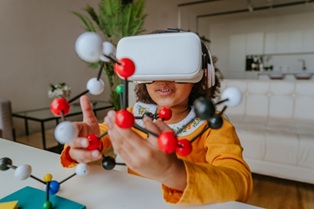
This early exposure matters. Research consistently shows that career aspirations form early, and that STEM engagement increases when learners can see and experience real applications of science. VR transforms abstract concepts into lived experiences—helping pupils understand not just what science is, but why it matters.
VR also allows training to be standardised across schools, colleges, and universities, regardless of geography. A learner in a rural school can receive the same high-quality experience as one based next to a major research hospital.
For educators facing tight budgets and limited lab access, VR offers scale without compromise—no consumables, no safety risks, and no class-size limits.
A Game-Changer for Medical & Pharmaceutical Manufacturing
In the medical and pharmaceutical sector, the benefits are even more pronounced.
Live laboratory space is one of the most expensive resources in the life sciences. Using it to train new staff often means slowing or stopping production. VR removes this trade-off entirely.
Trainees can repeat tasks dozens or even hundreds of times without wasting costly chemicals, reagents, or materials. Errors become learning opportunities rather than financial losses.
Crucially, VR also supports regulatory compliance and consistency. Standardised training environments ensure that procedures are taught identically across sites—an increasingly important factor in regulated industries.
As the UK seeks to strengthen its position as a global leader in advanced medicines manufacturing, scalable training solutions like VR will be essential.
Professor Ivan Wall: From Regenerative Medicine to Workforce Innovation
Professor Wall’s career bridges cutting-edge science and practical workforce development.

After completing a PhD in cell and molecular biology, researching wound healing, his work expanded into biomaterials, dental regeneration, and stem cell biology. In 2018, he became Professor at Aston University, where he led doctoral training and skills initiatives.
Since joining the University of Birmingham in 2022, his ambition has been clear: to help make Birmingham a hub for manufacturing cell and gene therapies, ensuring that patients can benefit locally from world-leading science. Resilience is a key part of that vision—ensuring the workforce is ready before demand outstrips supply.
A Blueprint for the Future of Education and Care
What Resilience ultimately demonstrates is that education no longer has to be constrained by physical space, cost, or risk.
VR does not replace hands-on experience—it prepares learners for it. By the time individuals enter real laboratories, care settings, or manufacturing facilities, they do so with confidence, familiarity, and a clear understanding of processes.
For education providers, care organisations, and pharmaceutical manufacturers alike, the message is the same: immersive learning is no longer experimental—it is essential infrastructure for the future.
As International Day of Education reminds us, how we educate today determines what we can build tomorrow. With initiatives like Resilience, the UK is not only training future medicine makers—it is reimagining education itself.