
Why Independent Estate Evidence Matters More Than Ever for Schools
Estate management has become one of the defining operational challenges facing schools, academies and trusts.
Ageing buildings, tightening compliance obligations and increasingly competitive capital funding have placed school leaders in a difficult position — expected to make high-stakes estate decisions with limited in-house technical capacity.
At the same time, the Department for Education’s expectations around evidence, procurement and statutory compliance continue to evolve. Independent professional advice is no longer a “nice to have”. It is becoming essential.
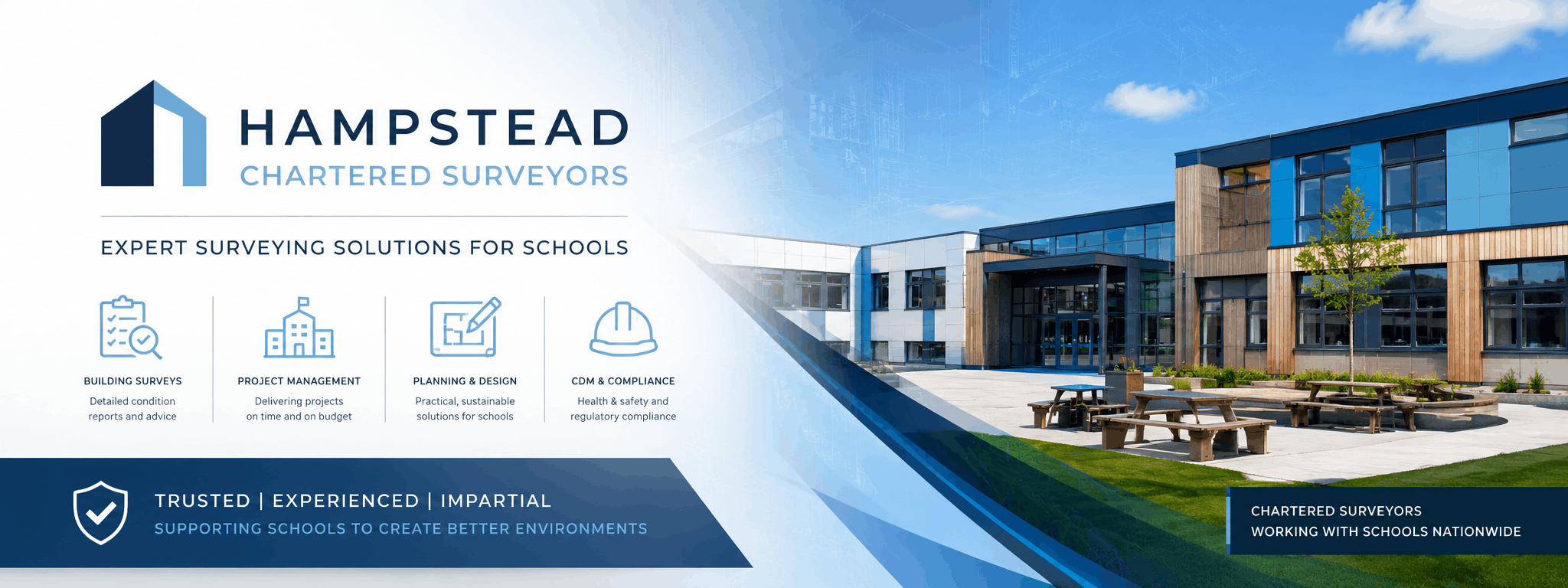
That is the position Hampstead Chartered Surveyors & Building Consultancy brings to the schools sector: independent, RICS-regulated surveying and building consultancy designed around the evidence and advisory needs of education estates.
The practice acts solely as a professional adviser to building owners and occupiers. It does not undertake construction works — a distinction that carries significant weight in today’s funding landscape.
The survey report is no longer simply a technical document. It has become a core funding and governance tool.
That independence is particularly relevant for schools pursuing Condition Improvement Fund support. Under current DfE requirements, evidence supporting CIF applications must come from an independent source — it cannot be produced by a firm that stands to benefit from the resulting works.
Four Priority Areas
Hampstead has structured its schools offer around the four areas where pressure is greatest: independent condition evidence, fire safety and compartmentation, specialist statutory compliance, and post-award project oversight.
Condition Evidence
Condition surveys, planned maintenance surveys and defect diagnosis reports are now expected to do far more than identify defects. They must demonstrate urgency, support strategic planning and provide a defensible evidence base for funding decisions.
CIF remains intensely competitive. The DfE assesses bids against three weighted criteria: Project Need, Project Cost and Project Planning. Schools need evidence that clearly demonstrates not only the existence of a problem, but why the proposed solution is appropriate, deliverable and strategically managed.
Planned maintenance surveys and stock condition programmes also help trusts demonstrate longer-term estate stewardship — an increasingly important consideration under the DfE’s Good Estate Management for Schools framework.
Alongside condition work, reinstatement cost assessments ensure a school’s buildings are insured for what they would actually cost to rebuild — an area where underinsurance is surprisingly common and rarely noticed until a claim arises.
For trusts taking on new schools or buildings, technical due diligence sets out what is being inherited — condition, compliance and likely capital cost — before commitments are made.
Fire Safety
Many school buildings — particularly older sites — contain decades of undocumented alterations that have compromised fire compartmentation and passive fire protection. Concealed breaches through fire-resisting walls and ceilings, poorly maintained fire doors and ineffective cavity barriers are more common than most schools realise.
The implications are both operational and regulatory. Under the Regulatory Reform (Fire Safety) Order 2005, schools carry statutory duties as Responsible Persons — accountability that typically rests with the headteacher or trust leadership. A suitable and sufficient fire risk assessment remains the foundational document underpinning these duties and is often the first document requested by inspectors and enforcing authorities.
Fire safety projects also remain among the highest-priority CIF categories.
Hampstead’s fire safety consultancy focuses on evidence-led surveys: compartmentation inspections, passive fire protection reviews, fire door inspections and broader fire risk assessment support that produce photographic, location-specific documentation capable of supporting both compliance and funding applications.
The practice can also assist with cladding assessments and cladding remediation works where external wall systems or façade materials require investigation, replacement or wider fire safety upgrades.
Independent evidence is becoming central to responsible school estate governance.
Specialist Statutory Compliance
RAAC identification, accessibility obligations and asbestos management all carry significant statutory and governance implications. Schools are increasingly expected to demonstrate not only awareness of their duties, but competent professional oversight.
For RAAC, responsible bodies must identify whether affected materials are present, implement mitigation where required and maintain appropriate reporting evidence. Equality Act obligations require Accessibility Plans informed by competent assessment of barriers affecting disabled pupils, staff and visitors. Asbestos management remains an area where schools frequently face documentation gaps, outdated plans or uncertainty around responsibilities.
Roof access and work at height is another recurring duty, particularly on older sites with fragile roof coverings, where schools must show that access and fall risks have been properly assessed.
Hampstead’s role here is to act as the school’s competent professional coordinator — reviewing plans, overseeing specialist investigations and integrating compliance into wider estate strategy.
Post-Award Project Oversight
Professional support should not stop once funding is secured. Many schools lack the in-house capacity to manage procurement, oversee contractors or administer complex capital projects — yet the post-award phase is precisely where delivery risk, cost escalation and quality failures most often emerge.
Contract administration, procurement support, clerk of works services, employer’s agent duties and CDM principal designer roles are all designed to ensure schools receive the standard of work they have been funded to deliver.
The Broader Picture
School estate management is becoming evidence-driven, compliance-focused and professionally scrutinised. The challenge for trusts and school leaders is no longer simply maintaining buildings — it is demonstrating that decisions are independently evidenced, strategically prioritised and robustly managed from survey through to delivery.
Independent chartered surveying support is rapidly moving from a specialist procurement to a central part of responsible school estate governance.
For further information
Hampstead Chartered Surveyors & Building Consultancy
Email: enquiries@hampsteadcharteredsurveyors.co.uk
Tel: 020 8054 8756
Website: hampsteadcharteredsurveyors.co.uk

