
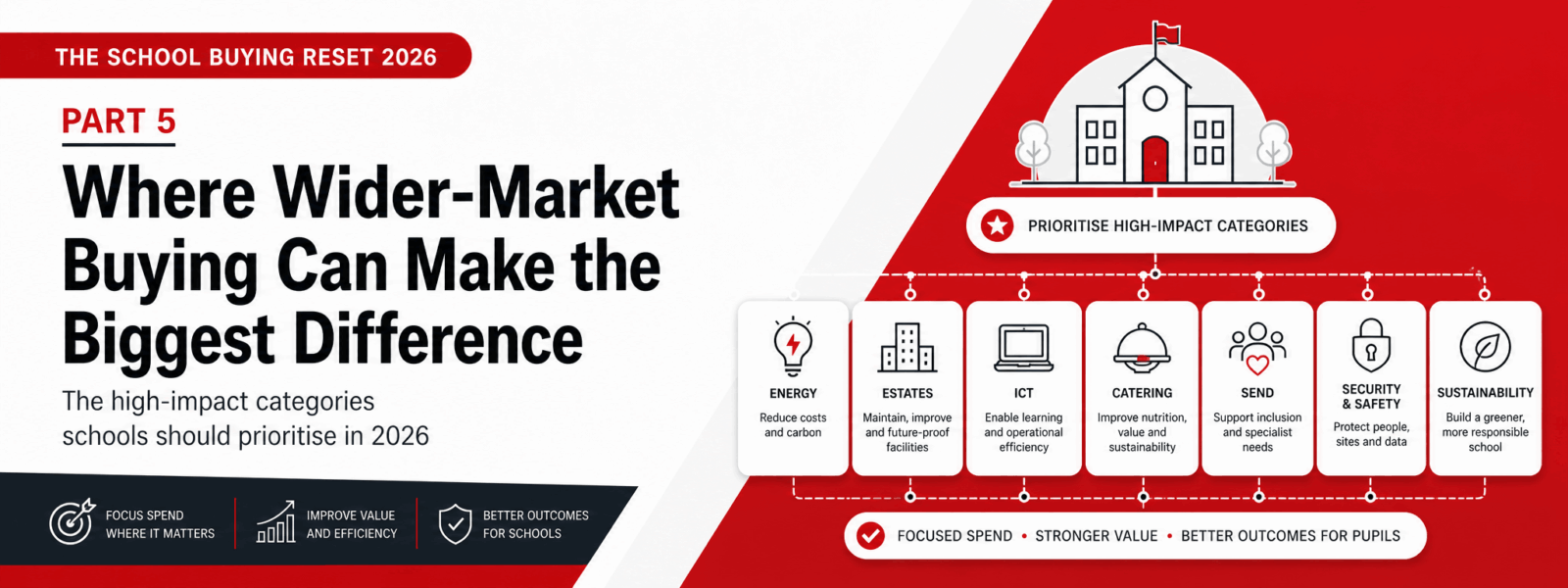
Some categories offer far greater potential for value, innovation and service improvement than others. Here’s where schools should focus their efforts in 2026.
This is Part 5 of The School Buying Reset 2026.
In Part 4, we shared a practical playbook for safely opening up competition and accessing a wider supplier market. Now we turn to the question every school leader and business manager should be asking:
Not every purchase justifies significant time and effort.
The key is to focus on the categories where cost, quality, service levels, compliance risk and innovation are changing quickly — and where the potential return on better procurement is highest.
In other words, wider-market buying should be targeted, not random.
High-Impact Categories for 2026
Here are the areas where many schools and trusts can achieve the greatest benefit by moving beyond default approaches.
1. Energy and Utilities
Energy remains one of the largest and most volatile non-staff costs for schools.
Contract timing, supplier performance, usage patterns and tariff structures can all make a significant difference to overall cost. Schools that simply renew or rely on familiar routes may miss opportunities to improve terms, reduce waste or access more specialist support.
Testing the wider market — including collective buying options, specialist brokers and energy efficiency support — can help schools secure better value and make more informed decisions.
2. Estates, Maintenance and Minor Works
Estates pressure has become a major operational issue for schools.
Reactive maintenance, planned works, compliance checks and minor projects all affect safety, learning environments and long-term asset condition. Where schools rely on the same route year after year, they may not always see the best combination of responsiveness, quality and value.
Wider-market testing can help schools compare response times, workmanship, project management, compliance capability and whole-life value.
3. ICT, Connectivity and Digital Services
Technology changes quickly, and school needs are evolving just as fast.
Devices, networks, cloud services, cyber security, MIS support, safeguarding technology and digital learning platforms all require careful comparison. A supplier or framework that was suitable three years ago may not be the best fit today.
Wider-market engagement can reveal better value devices, stronger support models, more flexible licensing, improved cyber resilience and more scalable digital infrastructure.
4. Catering and Food Services
Catering is no longer just a cost line.
Food quality, nutrition, sustainability, allergen management, parent expectations and pupil uptake all matter. Rising food costs also mean schools need to understand whether existing arrangements still provide the right balance of price, quality and service.
A wider-market review can help schools compare menu quality, cost control, supplier resilience, local sourcing, sustainability and service standards.
5. Cleaning and Facilities Services
Cleaning and facilities services have a direct impact on the daily school environment.
Poor performance can affect staff morale, pupil experience, health and safety, and the overall perception of the school. These contracts are often renewed because they are familiar, not always because they are still the strongest option.
Testing the market can uncover providers with better supervision, stronger performance management, improved flexibility and clearer reporting.
6. SEND Support Services and Specialist Provision
SEND support is one of the most sensitive and high-stakes areas of school procurement.
Demand is rising, budgets are constrained, and schools need support that is both appropriate and sustainable. In this category, wider-market buying is not simply about finding a cheaper supplier. It is about finding the right fit for pupils, staff and school capacity.
Careful market testing can help schools understand available specialist provision, compare quality and suitability, and secure support that better reflects pupil needs.
7. Security, Access Control and Fire Safety
Security, access control and fire safety sit at the intersection of compliance, safeguarding and operational risk.
Older systems, fragmented contracts or poorly integrated technology can create unnecessary costs and operational weaknesses. Frameworks can be helpful, but schools should still test whether newer solutions, better maintenance terms or more integrated support are available.
A wider-market review can support better compliance, improved site security and more predictable ongoing costs.
8. Professional Services: HR, Legal, Finance and Training
Professional services are often bought reactively, especially when a problem has already emerged.
But HR, legal, finance, compliance and staff training support can have a significant impact on risk management and leadership capacity. Schools should not only ask whether support is available, but whether it is responsive, specialist, good value and suited to the education sector.
Wider-market testing can help schools compare expertise, service levels, contract flexibility and practical support.
9. Classroom Resources and Curriculum Materials
Individual purchases may be small, but total spend across a school or trust can be significant.
Books, learning resources, equipment, subscriptions and curriculum materials are often bought through familiar suppliers. Over time, this can lead to missed opportunities for better pricing, improved resources or more relevant alternatives.
Aggregated spend reviews can help schools identify where wider-market comparison could create savings without reducing quality.
10. Sustainability and Energy Efficiency Projects
Sustainability is becoming a growing procurement priority for schools.
Solar PV, LED upgrades, heating improvements, insulation, water efficiency, waste management and decarbonisation projects can all carry long-term financial and environmental benefits. But they also require careful supplier comparison because quality, finance models, payback periods and maintenance terms can vary significantly.
Wider-market engagement can help schools assess technical quality, funding options, long-term savings and implementation risk.
How to Prioritise Your Efforts
Not every school will have the same priorities.
The right starting point is usually where spend, risk, renewal timing and operational impact overlap.
Use these questions to decide where to focus:
- Which categories represent the largest spend?
- Where have we been with the same supplier or framework for the longest time without review?
- Which areas have the biggest impact on daily school life and pupil experience?
- Where are costs rising fastest or service quality most variable?
- Which contracts are due for renewal in the next 12 to 18 months?
- Where could better procurement reduce pressure on staff time?
- Where could a better supplier improve outcomes, safety or resilience?
Start with one or two high-impact categories rather than trying to change everything at once.
The Practical Message for Schools
Wider-market buying does not mean reviewing every supplier, every year.
It means knowing where better procurement can make the biggest difference — and applying your time, effort and market testing where it is most likely to improve value, quality, service or outcomes.
What Comes Next
In Part 6 — the final instalment — we will explore how to build lasting procurement confidence and turn this approach into a repeatable, year-on-year capability.
Join The School Network
If you want to follow the full series and receive practical tools, templates and additional resources, we recommend joining The School Network.
The School Network exists to help schools move from supplier search to supplier strategy.
This series is designed to help schools take that first step — from reactive supplier search to confident supplier strategy.

