
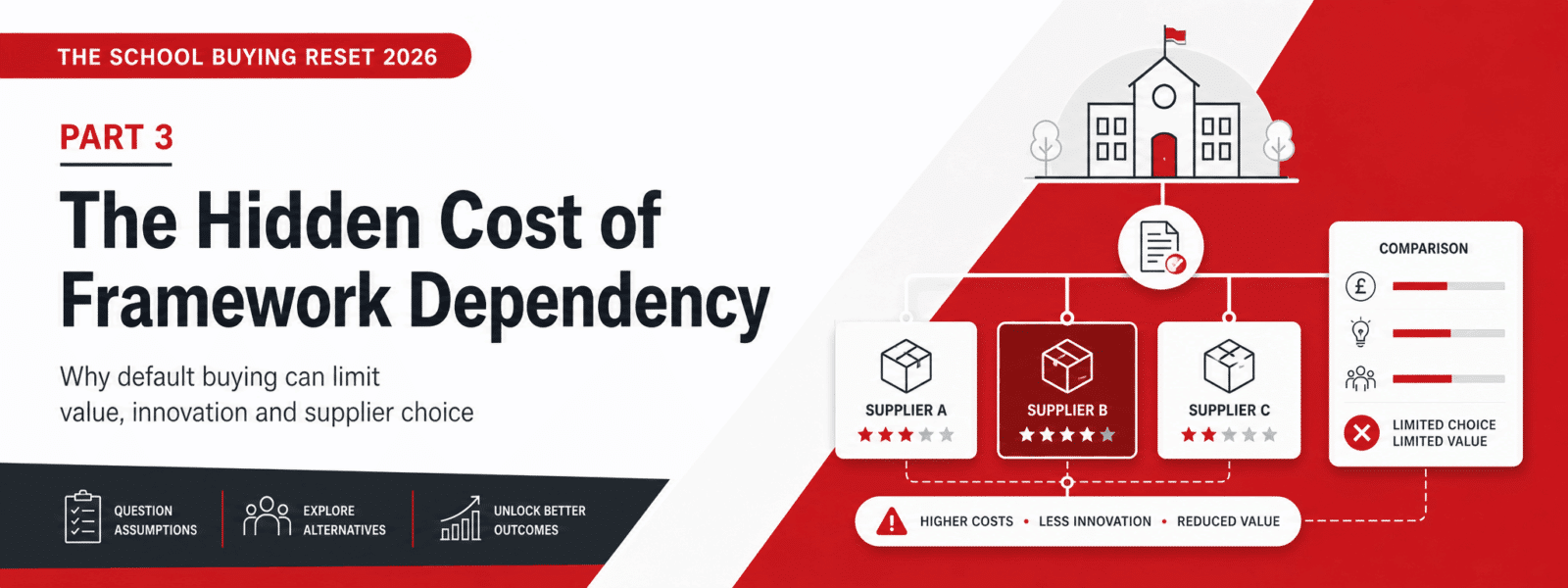
Frameworks can be a useful route to market, but when they become the default rather than one option among many, schools can miss out on better value, innovation and supplier choice.
This is Part 3 of The School Buying Reset 2026.
In Part 1, we established why procurement must now be treated as a strategic issue rather than an administrative task. In Part 2, we looked at what the Procurement Act 2023 actually changes — and how it gives schools more tools and more responsibility to engage the wider market.
Today we turn to one of the most common habits in school procurement: defaulting to familiar framework routes before asking whether the wider market could offer better value, quality or fit.
Frameworks Have a Role — But They Should Not Become the Ceiling
Let’s be clear from the outset: there is nothing wrong with using frameworks.
They can offer real benefits — speed, structure, pre-vetted suppliers and a clear route to compliant buying. For many schools, especially those with limited procurement expertise or capacity, frameworks provide a practical and lower-risk way to purchase goods and services.
The issue is not frameworks themselves.
The Hidden Costs of Default Buying
When frameworks become the automatic choice rather than a deliberate one, several hidden costs can begin to appear.
1. Reduced Visibility of the Wider Market
Schools can become less exposed to new suppliers, innovative solutions and changing market prices.
Over time, this can lead to missed opportunities — whether that means better value, stronger service, more suitable providers or solutions better matched to the school’s specific needs.
2. Weaker Competitive Pressure
Where supplier relationships are not regularly reviewed, competition can weaken over time.
That can reduce the pressure to improve value, service or innovation, particularly where the same suppliers are repeatedly selected without meaningful market testing.
3. Missed Opportunities for Better Value
Many schools only discover what else is available once they begin testing the market more actively.
Even in categories that have historically been bought through frameworks, there may be opportunities to find better pricing, stronger service levels, improved support or more flexible contract terms.
4. Limited Innovation and Local Impact
Some framework routes may naturally be more accessible to larger or more established suppliers.
That can make it harder for schools to discover smaller, local or specialist providers — including those that may offer stronger social value, more tailored support or better alignment with a school’s specific needs.
5. Opportunity Cost of Staff Time
Frameworks can save time in the short term. But if schools repeatedly buy from suppliers that no longer represent the best overall value, time can be lost elsewhere — through contract management issues, service problems, poor responsiveness or avoidable rework.
The question is not simply:
The better question is:
Real-World Impact
Consider a typical secondary school that has used the same framework route for estates maintenance and minor works for several years.
The process feels safe and familiar. However, when the school decides to test the market properly — using clear outcome-based specifications and a proportionate competitive process — it may discover:
- New suppliers offering better response times and service quality
- More competitive pricing
- Greater willingness to tailor services to the school’s specific needs
- Alternative approaches that had not previously been considered
The same pattern can apply across other categories — from catering and cleaning to ICT equipment, energy, estates, safeguarding technology and specialist SEND support.
The cost is rarely dramatic in any single year. It is the slow, cumulative effect of gradually paying more, receiving less innovation and having fewer options that builds over time.
Why Schools Default to Frameworks
There are understandable reasons why many schools lean heavily on frameworks:
- Limited internal procurement expertise
- Fear of getting the process wrong
- Time pressure
- Limited capacity to review the wider market
- A belief that “if it’s on a framework, it must be best value”
These are all valid concerns.
However, the Procurement Act 2023 has created more scope for schools to engage the market, test options and design proportionate processes — provided decisions are handled fairly, clearly and with proper documentation.
The Opportunity Cost
Perhaps the biggest hidden cost of framework dependency is not financial at all.
It is the opportunity cost of leadership attention and strategic focus.
When procurement is treated as something to be handled on autopilot, schools miss the chance to use buying decisions as a lever for improvement — whether that means improving learning environments, supporting local businesses, reducing carbon emissions, strengthening SEND provision or securing better value for every pound spent.
In 2026, this opportunity cost is becoming harder to ignore.
What Comes Next
In Part 4, we will provide a practical playbook for safely opening up competition and accessing a wider supplier market — without increasing risk or unnecessary complexity.
Join The School Network
If you want to follow the full series and receive practical tools, templates and additional resources, we recommend joining The School Network.
The School Network exists to help schools move from supplier search to supplier strategy.
This series is designed to help schools take that first step — from reactive supplier search to confident supplier strategy.

