
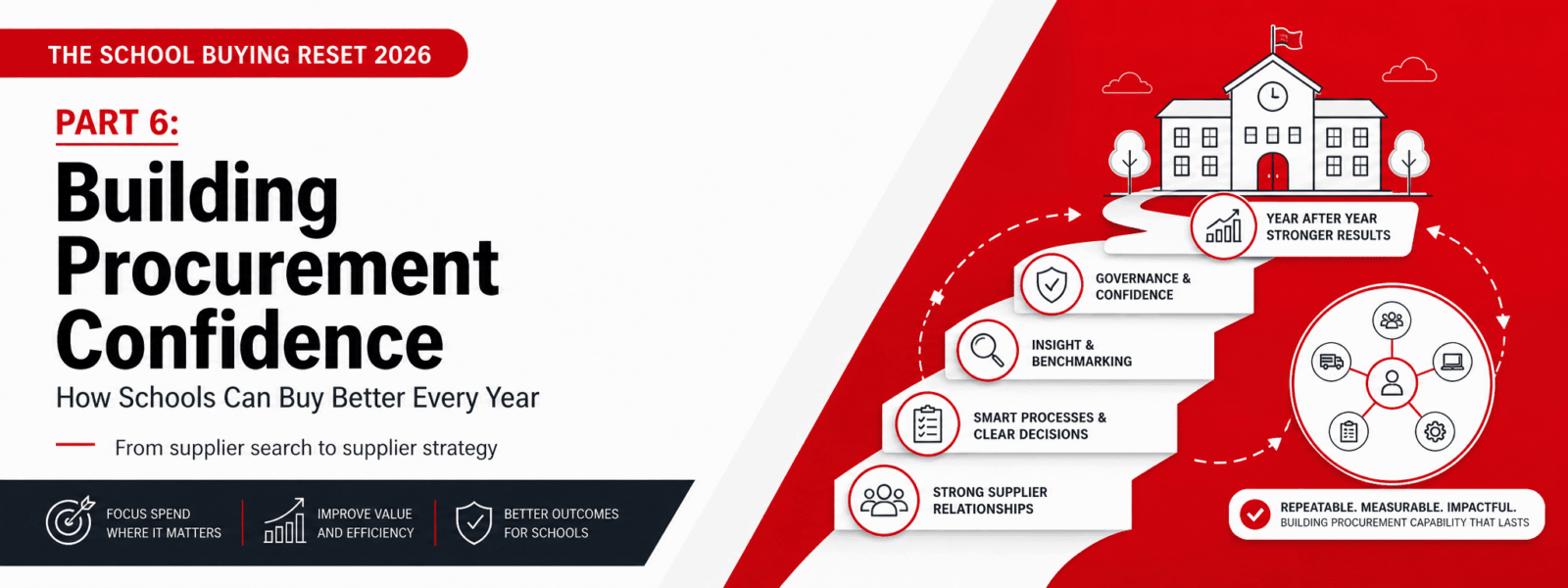
The future of school buying is not just about finding suppliers. It is about building a repeatable way to discover, compare, challenge and select the right suppliers for the right need.
This is Part 6 — the final instalment of The School Buying Reset 2026.
Over the past five parts, we have taken a clear journey together:
- Part 1 explained why procurement can no longer be treated as admin in 2026
- Part 2 showed what the Procurement Act 2023 really changes for schools
- Part 3 revealed the hidden costs of framework dependency
- Part 4 gave schools a practical playbook for opening up competition safely
- Part 5 identified the categories where wider-market buying can deliver the biggest impact
Now we turn to the most important question of all:
From One-Off Improvement to Lasting Capability
The schools that will thrive in the coming years are not those that run one successful tender or review one supplier contract.
They are the schools that build procurement confidence as an organisational capability — something that improves year after year.
This means moving beyond individual projects and creating repeatable habits, processes and governance that support better buying every time.
Better buying should not depend on one person, one renewal date or one urgent problem.
It should become part of how the school plans, reviews and improves.
The Foundations of Lasting Procurement Confidence
Here are the foundations schools need to build.
1. Treat Procurement as a Strategic Function
Procurement should sit alongside curriculum, finance, estates and HR as a core leadership responsibility — not something that only surfaces when a contract is due for renewal.
When procurement is discussed earlier, schools have more time to understand the market, compare options and make better decisions.
2. Build Simple, Repeatable Processes
Use the seven-step playbook from Part 4 as a standard approach.
Over time, this becomes second nature and reduces the risk of rushed decisions, unclear specifications or poor supplier comparisons.
The aim is not to make procurement more complicated.
The aim is to make good procurement easier to repeat.
3. Invest in Skills and Knowledge
Schools that develop procurement capability across the team make stronger decisions.
That may involve internal training, external support, peer learning or access to practical templates and guidance.
The key is to avoid procurement knowledge sitting with just one person. A stronger process should survive staff changes, pressure periods and leadership transitions.
4. Review and Learn After Every Major Purchase
After each significant contract award, take time to ask:
- What worked well?
- What could we improve?
- Did the supplier deliver what was promised?
- Did the process give us enough market visibility?
- Would we make the same decision again?
This continuous improvement mindset is what separates reactive buying from confident procurement.
5. Use Data and Benchmarking
Schools should regularly compare spend, supplier performance and contract outcomes against similar schools where possible.
This helps identify where current arrangements are working well and where there may be room for improvement.
Good benchmarking can help schools ask better questions before a contract is renewed.
6. Maintain Strong Governance
Clear approval processes, proper documentation and regular contract reviews protect the school and build trust with governors and external bodies.
Strong governance does not slow procurement down when it is built into the process early.
It gives schools the confidence to act.
The Real Goal: Supplier Strategy, Not Supplier Search
The central message of this entire series has been this:
Most schools default to familiar routes because they feel safer.
That is understandable.
But familiar does not always mean best.
The schools that will get ahead are those that move from reactive supplier search to confident supplier strategy — knowing how to test the market, compare options intelligently and make decisions that genuinely reflect their school’s needs, priorities and pressures.
How The School Network Can Help
This is where The School Network comes in.
We exist to help schools move from supplier search to supplier strategy.
Through The School Network, schools can access:
- Practical tools, templates and checklists
- Market intelligence and benchmarking
- Supplier discovery across a wide range of categories
- Peer learning and expert guidance
- Ongoing support to build internal procurement capability
The School Buying Reset 2026 series is just the beginning.
Our goal is to support schools in building the confidence, processes and networks they need to buy better — not just in 2026, but every year.
Final Thought
Procurement may not always be the most visible part of school leadership. But in 2026 and beyond, it is one of the most important.
Every pound spent wisely frees up resources for teaching, support and school improvement.
Every well-chosen supplier strengthens school resilience.
Every confident decision protects public money and builds trust.
The opportunity is there. The tools exist. The need is clear.
The question is no longer whether schools should move beyond framework dependency.
It is how quickly they can build the confidence to do so.
Thank you for following The School Buying Reset 2026.
Join The School Network
If you want to continue this journey and receive practical tools, templates, market insights and ongoing support, we invite you to join The School Network.
The School Network exists to help schools move from supplier search to supplier strategy.
This series is the starting point.
The real work — and the real opportunity — begins now.

